 an unofficial fan site
The new homepage of this site quotes Jacob Collier calling Snarky Puppy a “dangerously funky group of human beings.” I didn’t pull that from a press release. He said it to me, on camera, and I laughed out loud while he kept going. Here’s the story behind the quote, where the words come from, and why I’ve been using the phrase ever since.
Jacob’s line
In September 2016 I recorded a short pre-concert interview with Jacob. I asked him about working with Snarky Puppy. At 3:55 he says the band is an “extremely funky, dangerously funky group of human beings.” You can hear my delighted laugh right after it.
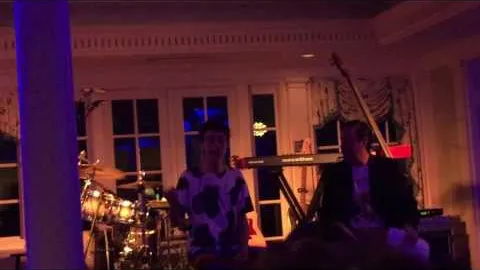
The video is on my YouTube channel as “Pre performance Interview Jacob Collier and SPF” (the link starts at 3:55). The homepage uses the second half of his line.
Where the word came from
“Funky” is older than “funk,” at least as a name for music. Most genre words run the other way: jazz gives you jazzy, blues gives you bluesy. Here the adjective came first. Etymonline dates the genre sense of the noun funk to about 1959 and calls it a back-formation from funky (Etymonline: funky, funk).
Before it was praise, it was a smell word. The noun funk meant a bad smell in English by the 1620s, probably by way of an old French verb meaning to give off smoke, and by 1784 funky could describe musty, aged cheese. Around 1900, in jazz slang, the word turned approving: earthy, sweaty, low-down in a good way. Buddy Bolden’s band played a tune known as “Funky Butt” (Historic New Orleans Collection), and in November 1953 the Horace Silver Trio recorded “Opus de Funk” for Blue Note.
There’s also a second, much-loved theory. In Flash of the Spirit (1984), art historian Robert Farris Thompson suggested that the jazz sense of funky seems to come from the Ki-Kongo lu-fuki, a word for strong body odor that, in his account, could praise someone who had truly worked hard at their art. It’s a classic, and I love it, but treat it as a theory. Dictionaries such as Etymonline trace funky to the English smell word instead, and nobody has settled the question.
The phrase before Snarky Puppy
Jacob didn’t invent “dangerously funky,” and as far as I can tell nobody gets credit for it. The earliest dated use I’ve found is a 1997 release note from the Monotonik netlabel, for a track by Twilight dated June 12, 1997: “another dangerously funky track” (archive.org, MOD#69). Monotonik used it again that October for a Splif Productions release (REL#109). That’s just the oldest one I could find, not the origin. Spoken and print uses are mostly unsearchable, and older ones probably exist.
The same year, Cheetos started using the slogan “Dangerously cheesy” (Wikipedia: Cheetos). Same template: dangerously plus a word ending in -y, meaning so good you lose a little self-control. I can’t show that either one influenced the other.
You may also see the phrase tied to Einstürzende Neubauten’s 1989 album Haus der Lüge. The line, “a dangerously funky aggro-crawl,” is real, but it comes from Ned Raggett’s AllMusic review, written after the album came out. It isn’t evidence of the phrase in 1989.
More recently, bassist Charles Berthoud turned it into a YouTube title formula. The first in his series, “Slap bass with WAH sounds DANGEROUSLY funky,” went up on March 20, 2022, and many more followed.
Why groove feels like that
There’s real science behind the “dangerous” part. In 2014, Maria Witek and colleagues had listeners rate drum breaks with different amounts of syncopation (PLoS ONE, 2014). The urge to move and the pleasure both peaked at medium syncopation, on a smooth inverted-U curve: too little and the groove is a march, too much and it falls apart. It’s a gentle hill, not a cliff, and somewhere near the top of that hill is where the “I can’t sit still” feeling lives.
Then there’s the stank face: the curled lip and squint you make when a groove hits hard, the same face you’d make at a bad smell. I love that the word has come full circle, from smell to groove and back to a smell face.
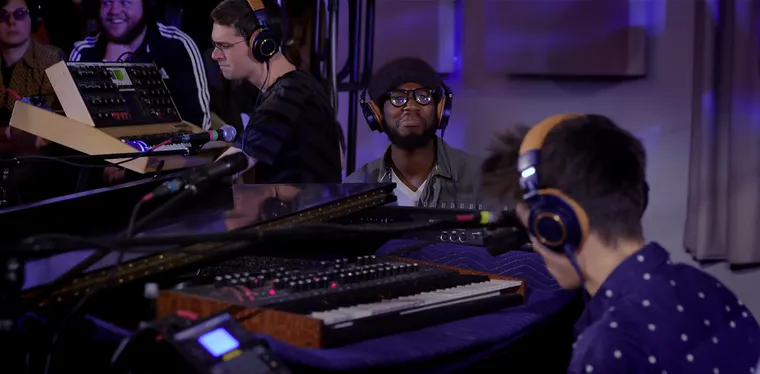
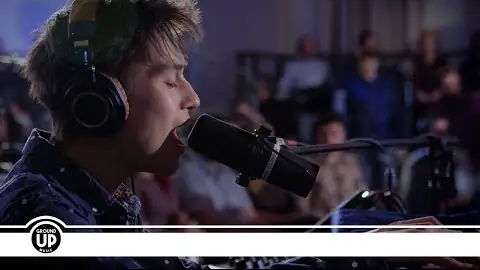
My favorite example is at 5:21 in “Don’t You Know” from Family Dinner Volume Two, Snarky Puppy with Jacob Collier and Big Ed Lee. Jacob is in the middle of his improvised piano solo, in 7, and keyboardist Cory Henry, sitting across from him, makes the most epic stank face I’ve ever seen. Watch it at 5:21 and tell me I’m wrong.
So why would a great groove make you look like you just smelled something? One theory goes that groove plays with prediction: the rhythm keeps setting up an expectation, bending it, then paying it off (Vuust and Witek, 2014), and the payoff feels good partly because pleasurable music gets the brain’s dopamine reward system going (Salimpoor and colleagues, 2011). Maybe the stank face borrows the disgust grimace as a “this is almost too much” signal, the same good-bad wince you make at hot sauce or a really ripe cheese.
Speaking of cheese: washed-rind cheeses like Limburger owe much of their funk to Brevibacterium linens, one of several microbes also linked to foot odor (Smithsonian). The word never really left the cheese cave.
My own uses
It turns out I had been saying it for years before I noticed.
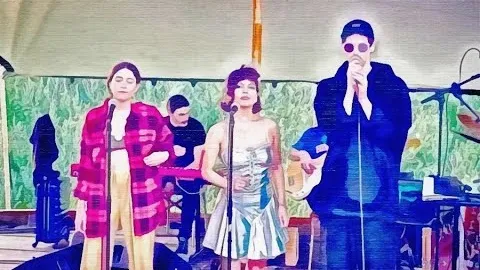
- February 2017. In my GroundUP Music Festival 2017 post, my note on Funky Knuckles was simply: “Dangerously funky fusion band. :-O”
- April 20, 2021. On X, about Charlie Hunter at the Family Dinner Volume 2 recording: “I’m the guy in the middle circle of the audience with the Maryland sweatshirt helplessly bobbing my head to the dangerously funky groove of the solo :-)” (That sweatshirt also shows up on my page about the videos I’m in.)
- July 28, 2022. An email to my friend Kyle Coughlin, subject “Louis Cole & Friends -- 2 weeks ago,” in full: “Dangerously funky IMHO :-)” plus a link to Louis Cole & Friends, “Overtime” (live 2022-07-10 @ studioinvites, Maastricht).
- 2023. A comment of mine under “Coney Bear” (Empire Central), which GroundUP Music NYC hearted: “Brilliantly-groovy and dangerously-funky composition by Bob Lanzetti. This is my favorite Empire Central video... But then again, I’m biased 😎”
So what did Jacob mean?
I think he meant a compliment with a warning label. “Dangerously funky” names an edge: a groove (or a cheese, or a natural wine) that gets close enough to chaos to set off a small alarm, and then, more often than not, pulls you in and gets your head bobbing before you’ve decided to.
Sources are linked inline. The Jacob Collier quote is from my own interview video; the rest of the dates come from the linked pages and, for the email, my own sent mail.